
· Series: Mapping Meaning · 12 min read
Before the Map, There Was a Practice: The Questions Around Meaning Audit
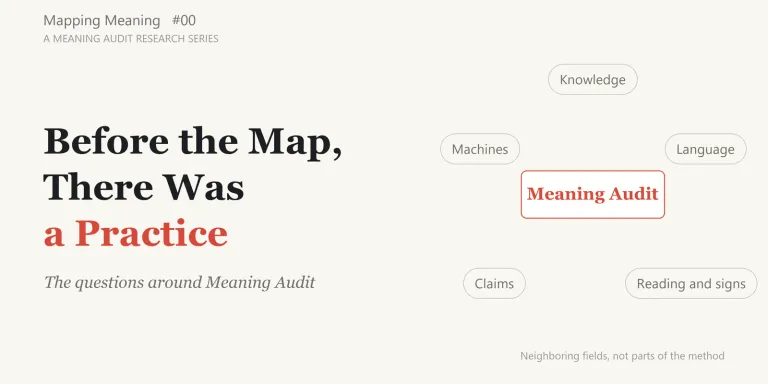
Mapping Meaning: A Meaning Audit research series, Episode 0
A method that came from work
For some time now I have been developing a method I call Meaning Audit.
It looks at documents, articles, and presentations, and traces the path from the source material to the claim that is finally presented. Somewhere along that path, meaning is added. Something is reshaped, something is inferred, and at some point a reading is adopted as a judgment, a conclusion, or a recommendation. Meaning Audit tries to find where that happened.
It is not primarily a way of deciding whether each statement is true or false. What I want to see is where the meaning moved. Looking back from where the series stands now, the shortest way I have found to put it is this: the points can be correct while the line connecting them is not.
I am not a philosopher or a linguist. I work in management, and I use AI and data in practice. Meaning Audit grew out of a discomfort I kept feeling in that work, and this series is written from that position: not as an expert’s explanation, but as notes made while looking around.
Then I noticed the neighbors
As the method took shape, I noticed something. The space I had been looking at, between a source and the meaning finally presented, was not empty territory. Other people had been thinking about it for a very long time, under other names.
There is a field that asks what entitles us to say we know something. There is a field that asks why what a sentence says and what it communicates can come apart. There is a field that has argued for roughly two centuries about what it means to read. There is a field that asks how words, numbers, and pictures come to stand for anything at all.
These fields are not the material Meaning Audit was built from. I did not study them and then design a method. The method came from practice; only afterward did I look around and find that many of the questions surrounding it had long histories in philosophy, linguistics, and related disciplines. Nothing in this series should be read as a claim that those fields prove Meaning Audit, or that Meaning Audit is an applied version of any of them.
What I wanted was a map: a rough picture of which fields stand around the problems Meaning Audit is trying to see.
Where this English edition begins
This series was first written in Japanese. Its opening article was this map, written as the plan for visits that were still to come. It named eight fields that I would visit, one at a time, in a first phase of research.
That first phase is now complete. All eight visits have been published in Japanese. This English edition retraces the same path, and it starts where the Japanese series started: with the map that sent me out.
I have kept the map largely as it was. The eight visits changed parts of it, and made some of its original boundaries less tidy than they first appeared. Some open questions were sharpened rather than answered. Where later work changed something, I say so below rather than quietly redrawing the original.
How to read the map
Meaning Audit divides the path from source to presented meaning into five broad stages:
- Evidence / Source: the materials, data, and evidence the output was built from.
- Interpretation: how those materials were read, selected, and summarized.
- Inference / Warrant: the reasoning that moves from an interpretation to a claim, and the reason given for making that move.
- Context / Pragmatics: meaning produced by headings, placement, vocabulary, figures, and the intended audience.
- Commitment: the point at which a meaning is adopted as a judgment, conclusion, or recommendation.

For each field below, I note where it seemed likely to touch these stages. That is my own estimate, made before the visits. It is not how the fields define themselves. At the time, I noted that a visit might well show a field touching a different stage than the one I had guessed.
Two of the stage names deserve a word of caution, because they overlap with established vocabulary. Pragmatics is the name of a field in linguistics and philosophy of language. Warrant is a term long used in the study of argument, notably in connection with Stephen Toulmin. Meaning Audit uses both words, but whether it uses them in the same sense as those fields is a separate question. For Pragmatics, the later visit to semantics and pragmatics (Episode 3) led me only as far as this: the two cannot simply be treated as the same concept. For Warrant, I have not yet done the research needed to say.
I keep each field to a few lines here. For the fields I visited, the substance belongs to their own episodes.
The neighboring landscape
I grouped nineteen areas into five clusters. They do not form a single system; each is a separate field with its own history. On the map, no lines connect Meaning Audit to them: these fields are its neighbors, not its source material.

Knowledge and evidence
| Field | Its question | Where it may touch Meaning Audit | Visited in Phase 1 |
|---|---|---|---|
| Epistemology | What is it to know something? What justifies knowledge, and where does it come from? | Between Evidence and Inference: does having evidence mean we know? | Episode 1 |
| Epistemology of testimony | How far may we rely on what others tell us? | The provenance of Evidence; how “according to…” is handled | Episode 2 |
| Social epistemology | Is knowledge only individual? How do groups, institutions, and systems take part in knowing? | Human Review; the decision not to let an audit end with the AI alone | Not visited |
| Philosophy of science | How does evidence support a theory? What lies between observation and explanation? | Inference / Warrant: the leap from Evidence to a claim | Episode 8 |
Linguistic meaning
| Field | Its question | Where it may touch Meaning Audit | Visited in Phase 1 |
|---|---|---|---|
| Semantics | What do words and sentences mean, and how is sentence meaning built from its parts? | Just before Interpretation: settling what is actually written | Episode 3 |
| Pragmatics | How do context, intention, and situation affect meaning? | Context / Pragmatics, which borrows part of its name from here | Episode 3 |
| Implicature and presupposition | Why is something communicated that was never said? Where are assumptions buried? | Between Interpretation and Context: what a document says without saying it | Episode 4 (implicature) |
| Speech act theory | Words do not only convey information; they promise, order, apologize, declare. What are they doing? | Commitment: the acts of recommending and concluding themselves | Episode 5 |
Reading and signs
| Field | Its question | Where it may touch Meaning Audit | Visited in Phase 1 |
|---|---|---|---|
| Hermeneutics | Is reading the extraction of a meaning that is already there, or does the reader bring something? | Interpretation as a whole, including the auditor’s own reading | Episode 6 |
| Semiotics | How do words, numbers, diagrams, and images mean anything? | Context / Pragmatics: meaning carried by charts, figures, and layout | Episode 7 |
| Legal interpretation | Is the meaning of a statute fixed by its text, its drafters’ intent, or its purpose? | Interpretation as a method: a field where schools of interpretation are made explicit | Not visited |
The construction of claims
| Field | Its question | Where it may touch Meaning Audit | Visited in Phase 1 |
|---|---|---|---|
| Argumentation theory | What fills the gap between grounds and a claim? | Inference / Warrant (see the caution above) | Not visited; a candidate for a later phase |
| Rhetoric | How does persuasive language move people? | Context / Pragmatics and Commitment: emphasis, order, metaphor | Not visited |
| Framing | How does presenting the same facts in a different frame change how they are received? | Context / Pragmatics: headlines, selection, emphasis | Not visited |
| Narrative theory | What is added when events are told as a story? | From Interpretation to Commitment: causes, motives, and characters filled in | Not visited |
| Cognitive psychology | How do people take in information, and where do their judgments go wrong? | The reading side, auditors included | Not visited |
Machine processing of meaning
| Field | Its question | Where it may touch Meaning Audit | Visited in Phase 1 |
|---|---|---|---|
| Knowledge representation | When knowledge is made machine-readable, what survives and what is lost? | Structuring Evidence; what is lost when material is broken into discrete units | Not visited |
| Knowledge graphs | When things are drawn as nodes and edges, where do the edges come from? | Inference: is an edge evidence or inference? | Not visited |
| RAG, GraphRAG, and AI meaning processing | When an AI retrieves sources and assembles an answer, what happens between the sources and what it generates? | All five stages; this is itself the kind of process Meaning Audit audits | Not visited |
The eight visits of the first phase covered nine of these nineteen areas: semantics and pragmatics shared Episode 3, and the visit to implicature did not take up presupposition. The other ten remain candidates, not findings.
Why these eight
The eight visits followed a deliberate order. First, the grounds of knowing: what it takes to say we know, and what changes when the knowledge comes from someone else (Episodes 1 and 2). Next, where the meaning of language is settled: what a sentence says, what it implies, and what it does (Episodes 3, 4, and 5). Then the two sides of reading: the reader who brings something to the text, and the signs, from words and numbers to charts and images, that carry meaning (Episodes 6 and 7). Finally, a field that deals with what lies between evidence and theory (Episode 8).
| Episode | Field | The question I took with me |
|---|---|---|
| 1 | Epistemology | On what grounds do we say we know? |
| 2 | Epistemology of testimony | How far does what someone tells us count as Evidence? |
| 3 | Semantics and pragmatics | Why can what is written and what is understood come apart? |
| 4 | Grice and implicature | How do we understand what was never said? |
| 5 | Speech act theory | Words do more than inform. What are promises, orders, and apologies doing? |
| 6 | Hermeneutics | Is reading the extraction of a meaning already in the text? |
| 7 | Semiotics | How do words, numbers, diagrams, and images mean anything? |
| 8 | Philosophy of science | What lies between Evidence and Theory? |

Each episode ends with a map on the same stage skeleton, marked with the questions I took from that field for the stages it touched; the first two maps left out Context / Pragmatics to keep the focus narrow. When I first drew this map, I hoped that after eight visits those markings would add up to a single map. They have not yet been combined. Whether and how to do that is still undecided.
What remains unknown
The map itself raised questions that it could not answer, and most of them are still open.
- Nineteen areas may not be enough. There may be neighboring fields I have not thought to include.
- I placed each field near the stages it seemed most likely to touch. Since then, several visits have led me to place questions from a field at more stages than I had guessed, which is a reason to treat every placement on this map as provisional.
- Whether Meaning Audit’s Pragmatics and Warrant mean what those words mean in the fields where they are established terms remains open. For Pragmatics I have a partial answer; for Warrant, none yet.
- For rhetoric, narrative theory, and knowledge representation, I have not yet chosen where to begin reading. I intend to decide that only once I know what I want to learn from them.
The map is still meant to be redrawn whenever a visit changes it.
Sources
These are the entry points I used for each area. The fields visited in Phase 1 are discussed in their own episodes; this article does not summarize any field’s doctrines.
- Steup, M. & Neta, R., “Epistemology,” Stanford Encyclopedia of Philosophy (substantive revision 2024-10-26). https://plato.stanford.edu/entries/epistemology/
- Ichikawa, J. J. & Steup, M., “The Analysis of Knowledge,” SEP (substantive revision 2026-01-21). https://plato.stanford.edu/entries/knowledge-analysis/
- Leonard, N., “Epistemological Problems of Testimony,” SEP (first published 2021-04-01). https://plato.stanford.edu/entries/testimony-episprob/
- O’Connor, C., Goldberg, S. & Goldman, A., “Social Epistemology,” SEP (substantive revision 2024-03-22). https://plato.stanford.edu/entries/epistemology-social/
- Crupi, V., “Confirmation,” SEP (substantive revision 2025-08-04). https://plato.stanford.edu/entries/confirmation/
- Korta, K. & Perry, J., “Pragmatics,” SEP (substantive revision 2024-05-28). https://plato.stanford.edu/entries/pragmatics/
- Davis, W., “Implicature,” SEP (substantive revision 2024-01-10). https://plato.stanford.edu/entries/implicature/
- Beaver, D. I., Geurts, B. & Denlinger, K., “Presupposition,” SEP (substantive revision 2021-01-07). https://plato.stanford.edu/entries/presupposition/
- Green, M., “Speech Acts,” SEP (substantive revision 2020-09-24). https://plato.stanford.edu/entries/speech-acts/
- George, T., “Hermeneutics,” SEP (substantive revision 2025-04-30). https://plato.stanford.edu/entries/hermeneutics/
- Atkin, A., “Peirce’s Theory of Signs,” SEP (substantive revision 2022-08-04). https://plato.stanford.edu/entries/peirce-semiotics/
- Greenberg, M., “Legal Interpretation,” SEP (first published 2021-07-07). https://plato.stanford.edu/entries/legal-interpretation/
- Dutilh Novaes, C., “Argument and Argumentation,” SEP (first published 2021-07-16). https://plato.stanford.edu/entries/argument/
- Toulmin, S., The Uses of Argument, Cambridge University Press, 1958.
- Entman, R. M., “Framing: Toward Clarification of a Fractured Paradigm,” Journal of Communication 43(4), 1993. https://doi.org/10.1111/j.1460-2466.1993.tb01304.x
- Hogan, A. et al., “Knowledge Graphs,” ACM Computing Surveys 54(4), 2021. https://doi.org/10.1145/3447772
- Lewis, P. et al., “Retrieval-Augmented Generation for Knowledge-Intensive NLP Tasks,” 2020. https://arxiv.org/abs/2005.11401
- Microsoft, GraphRAG documentation. https://microsoft.github.io/graphrag/
The Japanese original of this article: 「意味の監査」の周りには、どんな学問があるのか