
· Series: Mapping Meaning · 16 min read
My Friend Said, "The Shop Is Closed." Do I Know It Now?
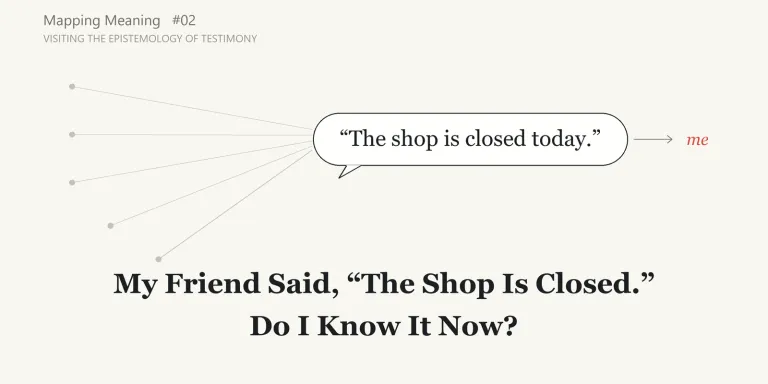
Mapping Meaning, Episode 2: Visiting the Epistemology of Testimony
“The shop is closed today.”
There was a shop I was planning to visit. Before I left, a friend sent me a message:
The shop is closed today.
I believed it and stayed home. I had not gone to look. I had not seen a notice on the door, and I had not called the shop. Still, I changed what I did because of what I was told.
Do I now know that the shop is closed today?
If my friend had walked past and seen a notice, that would be easy to believe. But suppose instead that my friend had heard it from someone else. Or saw it on social media. Or just has a feeling. Or remembers that it was closed last Tuesday too.
Any of these would come out as the same sentence: “The shop is closed today.” The sentence is identical; what stands behind it is not.

Once I started thinking this way, more questions followed. Who said it? What did they see? How far can I trust them? Did they themselves only hear it from someone else? Is there anything pointing the other way?
I did not see it myself
Thinking a little further, I noticed something about my own knowledge. A large part of what I think I know is not something I have checked directly.
I did not witness the historical events I know about. What happens in distant countries, and most of what I know about science, reaches me through what someone wrote or said. When a doctor explains my test results, I am not reading the results myself.
“It is risky to believe what you have not seen for yourself” is true up to a point. Taken all the way, it would make ordinary life almost impossible. Every day, we use other people’s words as a way of knowing.
So the question is not whether to believe what other people tell us. It is when, and how far.
This is a question about testimony
In Episode 1, I noted the sources of knowledge that the SEP entry “Epistemology” names: perception, introspection, memory, reason, and testimony. The last of these, being told something by someone, has its own area within epistemology: the epistemology of testimony.
As before, what follows is not an expert’s explanation but a record of what I could understand from my reading. My entry point was Nick Leonard’s Stanford Encyclopedia of Philosophy (SEP) entry “Epistemological Problems of Testimony.” It opens: “So much of what we know about the world, e.g., history, science, politics, one another, etc., comes from the testimony of others.” What I had just noticed seems to be where the field begins. The same paragraph goes on to say that while testimony is clearly an indispensable source of knowledge, saying exactly how we learn from a speaker’s say-so has proven difficult.
In everyday English, testimony suggests courtrooms and witness stands. In epistemology, the word covers much more ordinary cases. The entry mentions eyewitness testimony and the law as one set of questions among several, but its own examples are everyday: a friend tells you that your favorite team won last night’s game; in a new country, a stranger tells you that your hotel is three blocks down the road. My friend’s message about the shop belongs with these.
How exactly to define testimony is itself debated. According to the entry’s final section, it is widely accepted that one must assert something in order to testify to it, but there is much debate about whether asserting it is enough. I will not go into the definition here. For this episode, it is enough that a friend’s “The shop is closed today” is the kind of case the field is talking about.
Why should I believe my friend?
This was the part I most wanted to understand. My friend says the shop is closed. Why may I believe it?
Several reasons come to mind. This friend has rarely told me anything wrong. They have no reason to lie. Or they might have told me that they walked past and saw a notice.
Or, more simply: when someone tells you something and you have no particular reason to doubt it, perhaps you may believe it, at least for now.
These two lines of thought sound alike, but they are quite different. On the first, believing what someone tells me requires reasons of my own, separate from the telling itself, for thinking that the speaker is reliable: their track record, or the absence of any motive to mislead me. On the second, if I have no reason for doubt, what people tell me can, to some extent, be believed on its own terms.
The SEP entry calls these two positions Reductionism and Non-Reductionism. The names come from one of the field’s central questions: is testimony a basic source of justification, or can testimonial justification be reduced to a combination of other sources, such as perception, memory, and inference?
Reductionists, the entry says, “maintain that in order to acquire testimonial justification, one must have positive reasons for thinking that the speaker in question is a reliable testifier.” Non-Reductionists deny that such reasons are needed. Instead, on their view, “we have a defeasible but presumptive right to believe what people tell us.” In plainer terms, that is a default entitlement to believe, which reasons for doubt can defeat. The entry is careful here: on this view, you are justified as long as you have no reason to think that what you were told is false or unlikely to be true, or any such reason you have has itself been answered. Having no such reason is not quite the same as simply feeling no doubt, and, as the next sections show, some Non-Reductionists ask more of the hearer than that.
In everyday words, the two positions ask different questions. One asks, “Do you have a reason to trust this person?” The other asks, “If you have no reason to doubt them, why not believe them?”
Neither answer is simple
Both positions face objections, and neither is a single view.
Reductionism itself comes in two forms. Global Reductionism asks for positive reasons to think that testimony in general is reliable. Local Reductionism asks instead for reasons to think that this speaker is reliable on this occasion.
One objection raised against Local Reductionism uses the directions example. You arrive in a new country, ask someone on the street for directions, and are told that your hotel is three blocks down the road. You know almost nothing about this person. Yet it seems that you are justified in accepting what they tell you, and it is hard to see how Local Reductionism can accommodate that.
Non-Reductionism faces the opposite worry: gullibility. The entry gives an example on the Reductionist side of the argument. If no positive reasons were needed, one could be justified in believing “the say-so of a random blogger on an arbitrary website,” as long as one had no reason to doubt it.
And some philosophers take neither side. The entry describes several hybrid views, among them one on which both the hearer and the speaker play an important role in testimonial justification (“it takes two to tango, so to speak”), and then adds: “Whether any of these hybrid views will ultimately succeed is still very much an open debate.”
In Episode 1, I was surprised to find that there was no agreed definition of knowledge. Here, too, there was no single answer to why we may believe what others tell us. What I did learn is that the choice is not between two positions only. There are several positions in between.
What does the hearer have to do?
Reading this debate, I noticed that the question is not only whether the speaker is reliable. It is also what the hearer is doing.
Even among Non-Reductionists, the entry notes, some hold that simply lacking reasons for doubt is not enough. On their view, the hearer must also be sensitive to, or “on the lookout for,” the presence of defeaters (reasons that would defeat the entitlement) in their environment.
Back to my friend’s message. On that view, whether I may believe it does not depend only on my friend. It also matters whether I am in a position to notice signs pointing the other way: for example, that today is a public holiday, so the shop might be open on a day it would normally be closed.
On the speaker’s side, a separate section of the entry discusses authoritative testimony. Its example is a warning: “This plant is Pacific Poison Oak. Don’t touch it!” In one version, the person who told you lives nearby and knows a little about plants. In the other, the person has a PhD in plant biology and studies that particular plant. The entry says that in both cases you have acquired testimonial knowledge, but that in the second your belief seems better off, epistemically speaking.
What I took from this is that “Who said it?” is not the only question. There is also: what position was that person in to know?
Can testimony create knowledge?
Usually we think of testimony as passing knowledge along. My friend knows the shop is closed, tells me, and so I can know it too. If that is right, then if my friend did not know, I could not know either.
The entry, however, lists this as one of the field’s big questions: “Can testimony generate knowledge, or can it merely transmit it?” Put another way, can a hearer come to know something from a speaker who does not know it?
The example it discusses stayed with me. A biology teacher with creationist commitments has read the relevant textbooks, but does not believe, and so does not know, that Homo sapiens evolved from Homo erectus. She teaches it to her fourth-grade students anyway, and they come to believe it on the basis of what she tells them. The argument is that the students can come to know it, even though their teacher does not.
I do not yet know what to make of this example. But it showed me that three questions can come apart: who said it, whether that person knew it, and whether the hearer can be said to know it.
Is AI output testimony?
Now back to the question I left open at the end of Episode 1. Can an AI’s output be treated as something someone told me?
The SEP entry I read did not discuss AI or machine output at all. It covers individual speakers, and also groups, such as a United Nations commission stating something in a report. Testimony from a group of people is discussed; AI is not.
So from here on, this is my own thinking.
There are similarities. In both cases, I receive information from outside that I have not checked myself, and I use it to decide what to do. If an AI’s answer says the shop is closed and I stay home, and if my friend’s message says the same thing and I stay home, the situation looks structurally similar from where I stand, as the one receiving the information.
The differences are large, though. Much of the discussion I read seemed to assume that a speaker believes something, intends to tell the hearer something, may be sincere or insincere, and can be assessed as reliable or not. I cannot assume that an AI believes, intends, or is sincere in the same sense as a person.
Only the question of reliability seems as if it might apply. But whether asking it of an AI is closer to asking “Is this person reliable?” or to asking “Is this instrument accurate?” is something I do not yet know.
Within what I read for this episode, I found no answer to whether AI output can be called testimony.
What this adds to Meaning Audit
From here on, I turn to my own side of this: what it means for Meaning Audit.
Someone said the shop is closed. That the statement is on record is not the same as the shop actually being closed. And it also matters whether that person saw it themselves or heard it from someone else.
In Meaning Audit’s terms, the record “My friend said the shop is closed” can be treated as Evidence / Source. (As in Episode 1, I write Evidence with a capital E for the Meaning Audit stage, and evidence in lowercase for the everyday and epistemological word. It is only a way of keeping the two apart on the page.) If the message is still there, I can trace who said what, and when.
Between that record and the conclusion “The shop is closed,” however, there is still a gap: what my friend based the statement on. Meaning Audit calls the step from grounds to a conclusion Inference / Warrant. If I cannot tell whether my friend saw a notice or heard it from someone, that step cannot be confirmed.
So I want to record two things separately:
Who said it?
What did they base it on?

The first can often be confirmed from the record. The second often cannot. In the labels Meaning Audit uses for the status of information, “My friend said the shop is closed” can be KNOWN, meaning directly confirmed in the available materials. “My friend saw the notice” stays UNKNOWN unless my friend actually said so. Filling it in with “they probably saw it” would let an UNKNOWN become a fact by way of a guess, and that is exactly the move Meaning Audit is meant to stop.
Meaning Audit already looks for cases where trimming, paraphrasing, or attribution changes what a speaker meant. Getting wrong who said something changes the meaning. After reading about testimony, I could see another layer: getting wrong what that person based it on can change the meaning too. This also matters when AI is used to handle what other people have said.
Still, the two are not the same. The epistemology of testimony asks when a hearer may believe what they are told. Meaning Audit traces how a statement is handled within a document and where its meaning changes. In this episode, I was drawing the line between them this way: Meaning Audit was not being used to decide whether the hearer should believe. Even so, there seems to be a great deal to learn from this field about not overlooking the speaker’s grounds.
A map from Episode 2
As in Episode 1, I set the stages of Meaning Audit beside the questions this field raises. They are separate layers: Meaning Audit’s stages form one, and the questions from the epistemology of testimony form the other. I have not inserted the field’s ideas into Meaning Audit’s stages.

The map leaves out the Context / Pragmatics stage, to keep the focus on where the epistemology of testimony meets Meaning Audit. The questions from the field are not a formal model; they are questions I picked up from what I read for this episode.
What I learned
- Much of what we take ourselves to know is not something we checked directly. The epistemology of testimony starts from there.
- In epistemology, testimony is not limited to courtrooms. It includes everyday statements such as a friend’s “The shop is closed today,” although how to define it exactly is debated.
- Epistemologists disagree about whether a hearer needs separate positive reasons for thinking the speaker reliable (Reductionism) or has a defeasible default right to believe it (Non-Reductionism). There are hybrid views as well, and the debate is not settled.
- On one view, whether I may believe what I am told depends not only on the speaker but also on whether I, as the hearer, am alert to signs pointing the other way.
- “Who said it?” and “What did they base it on?” are better kept apart.
What remains open
- Can AI output be called testimony? If not, should it be treated as a different source of knowledge, more like an instrument or a record? (The sources I read did not discuss AI.)
- When a statement passes from person to person and the chain grows long, how far back do we need to trace it? How does this relate to the argument that testimony can generate knowledge in a hearer even when the speaker does not have it?
- Whose testimony is a group’s report, such as one from a UN commission? Treating organizations and institutions, not individuals, as sources of knowledge seems to connect to social epistemology, which I have not read yet.
Next
Knowing who said it is still not enough. Even “The shop is closed today” can convey different meanings depending on the situation in which it is said.
Next, I visit the difference between what is written and what is conveyed.
Sources
- Leonard, N., “Epistemological Problems of Testimony,” Stanford Encyclopedia of Philosophy (first published 2021-04-01). https://plato.stanford.edu/entries/testimony-episprob/
- Steup, M. & Neta, R., “Epistemology,” Stanford Encyclopedia of Philosophy (substantive revision 2024-10-26). https://plato.stanford.edu/entries/epistemology/
The works mentioned within Leonard’s entry (for example by Coady, Lackey, Hume, and Reid) were not read for this episode, and nothing in this article is attributed to them directly.
The Japanese original of this article: 誰かが「休みだよ」と言った。では、私はそれを知っているのか