
· Series: Mapping Meaning · 18 min read
Someone Said, "It's Getting Late." What Did They Mean?
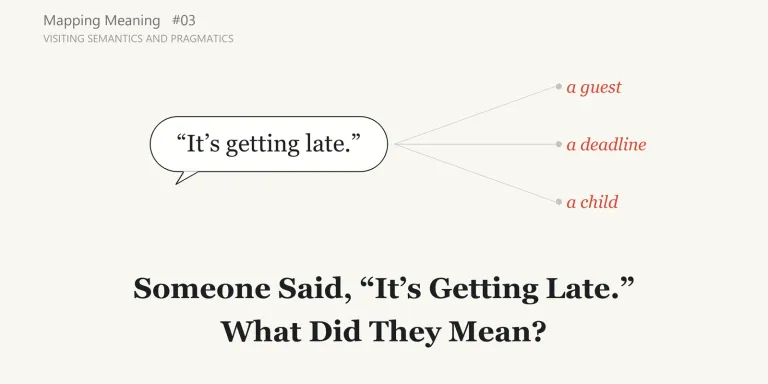
Mapping Meaning, Episode 3: Visiting Semantics and Pragmatics
“It’s getting late.”
Imagine the same remark made in three different situations.
In the first, a guest has stayed late at someone’s home. The conversation has gone well, and it is nearly midnight. The host says:
It’s getting late.
The guest probably hears something like: perhaps I should leave soon.
In the second, a proposal is due tomorrow, and the team still has not settled on a direction. A manager looks at the calendar and says:
It’s getting late.
This sounds more like: we are running out of time, and there may not be much room left to change direction.
In the third, a child is still up long past bedtime. A parent says:
It’s getting late.
This is close to: time for bed.
The words are exactly the same each time. What the listener takes from them is quite different.

Is what the sentence itself means the same thing as what the listener received?
What does the sentence itself say?
Let me set aside, for a moment, who said it and where.
What does the sentence “It’s getting late” say, as a sentence?
In the first and third scenes, “late” is about the time of day. In the second, it is about how close we are to the end of a stretch of time that ends with the deadline. I am not sure whether that is a second sense of the word or the same sense applied to a different period. Either way, the words alone do not settle which reading is in play.
Semantics is one of the fields concerned with what words and sentences mean. For this visit, my entry point was the Stanford Encyclopedia of Philosophy (SEP) entry “Pragmatics,” by Kepa Korta and John Perry. For the semantics side, I checked Jeff Speaks’s SEP entry “Theories of Meaning.” As before, this is not an expert’s explanation but a record of what I could understand from my reading.
“Theories of Meaning” begins with a warning: the term “theory of meaning” has been used to mean a great number of different things. The entry focuses on two of them. The first, a semantic theory, is a theory that assigns semantic contents to the expressions of a language: which meaning goes with which word or sentence. That is the side that matters most for my question here.
But we never hear sentences alone
In Episode 2, I separated two questions: who said something, and what they based it on. Thinking about “It’s getting late,” I noticed that even once I know who said it and which words they used, I may still not know what was conveyed.
In real conversation, we do not only process sentences. We also use, almost without noticing, who is speaking, when, and where, what has just happened, and how we stand in relation to the speaker. That is why the same words can be taken differently by a guest and by a child.
The SEP entry “Pragmatics” opens with a joke, which it attributes to Voltaire while noting that the lines are also attributed to H. L. Mencken and Carl Jung: when a diplomat says yes, he means “perhaps”; when he says perhaps, he means “no”; when he says no, he is not a diplomat. Whatever this says about diplomats, the entry takes it as a reminder that more is involved in what we communicate than what we literally say.
It then lists the kind of questions that, roughly speaking, characterize the field it calls pragmatics: how the meaning of words, what speakers mean by them, the circumstances in which they are uttered, the speakers’ intentions and actions, and what they manage to communicate are related to one another. Put as an everyday question: what were you really trying to say?
The main text begins: “Pragmatics deals with utterances.” An utterance, in the entry’s sense, is a specific event: the intentional act of a particular speaker at a particular time and place, typically involving language. Logic and semantics, by contrast, have traditionally dealt with properties of types of expressions, properties that stay the same from one use to the next. The entry adds that pragmatics is sometimes characterized as dealing with the effects of context, while warning that “context” is often used in more limited senses.
At this point I had a simple picture in mind. Semantics is about the meaning of the sentence itself; pragmatics is about meaning in context.
As a first approximation, that seemed useful. The further I read, though, the less sure I became that the two could be separated so cleanly.
“I will come here tomorrow.”
The first doubt came from a sentence like this one:
I will come here tomorrow.
On its own, this sentence does not tell you what is being said. Who is “I”? Where is “here”? When is “tomorrow”?
With “It’s getting late,” the situation seemed to add something the sentence did not say: please go home, or go to bed. With “I will come here tomorrow,” the situation is needed before the sentence says anything definite at all. Context does not only add meaning on top of what was said. Sometimes it is needed to settle what was said in the first place.
The SEP has an entry on words of this kind, “Indexicals,” by David Braun and Alexandru Radulescu. It opens: “An indexical is, roughly speaking, a linguistic expression whose reference can shift from context to context.” Its examples include you, I, here, today, yesterday, he, she, and that. When John says “I am hungry,” he says that he is hungry; when Mary says the same sentence, she says that she is.
According to the entry, many philosophers hold that indexicals have two sorts of meaning. One stays the same in every use and is often called linguistic meaning; the other, often called content, can change from context to context. On this view, the word “I” means the same thing whoever uses it, but who it picks out depends on who is speaking.
When I went back to the “Pragmatics” entry with this in mind, I found something I had not expected.
The boundary was harder to draw than I thought
To discuss the different features of utterances that theorists have focused on, the “Pragmatics” entry finds it helpful to use a reference point: what a speaker says. It distinguishes what it calls near-side pragmatics from far-side pragmatics.
Far-side pragmatics is concerned with what happens beyond saying: what the speaker does in or by saying something, and what is communicated beyond what is said. Near-side pragmatics is concerned with certain facts that are relevant to determining what is said in the first place.
Near-side pragmatics, the entry says, includes, but is not limited to, resolving ambiguity and vagueness, and working out what proper names, indexicals, and demonstratives refer to. For words like “I,” “now,” and “here,” basic facts about the utterance are needed: who is speaking, and when and where.
So working out what “I will come here tomorrow” says counts, on this way of dividing things, as part of pragmatics. I think working out which reading of “late” is in play in the manager’s remark would count too: whether the word has two senses there or one, settling it looks like resolving ambiguity or vagueness. Some of what I had placed on the side of “the meaning of the sentence itself” already had context inside it.
The entry also describes how the field used to see this. In what it calls the classic period, studies of the far side rested on a premise: that one could draw a fairly clear distinction between what is said, as the output of semantics, and what is conveyed or accomplished beyond it. “What is said” worked as a kind of border: semantics on the near side, and the parts of pragmatics that the classic period focused on, on the far side. The entry calls this a premise “increasingly undermined by developments in pragmatics itself.”
Border disputes
A later section of the entry is titled “Border Disputes.” Its example is a phone call. John is on a patio at Stanford, talking on the phone with Kepa, who is in Donostia, and says, “It is raining.” Arguably, the entry says, what John says is that it is raining in Stanford. That is what he intends Kepa to understand. Yet “Stanford” appears nowhere in the sentence. How did it get into what he said?
Contemporary approaches, the entry says, are often classified by their view of two models of linguistic communication: one in which communication is a matter of coding and decoding, and one centered on recognizing what the speaker intends. The two models are not inconsistent, the entry notes; the question is how central each one is. It describes literalists, who think semantics is basically autonomous with little “pragmatic intrusion,” and among whom it distinguishes minimalists and “hidden indexical” theorists; contextualists, who see pragmatics at work at every level; and other positions besides. There is, the entry says, general agreement that intuitions about “what is said” cannot by themselves carry much theoretical weight, and “considerable disagreement” about how to interpret content of this kind theoretically.
The entry ends with a section that simply collects definitions of pragmatics. Many of them contrast pragmatics with semantics, and not all in the same way. One treats pragmatics as the relation of signs to their interpreters. Another assigns an inquiry to pragmatics whenever it refers explicitly to the user of a language, and to semantics when it looks only at expressions and what they designate.
I started with a clean distinction. What I found was that the boundary itself is disputed. In Episode 1, I was surprised that there was no agreed definition of knowledge. This was a similar surprise, and it did not answer my question.
“Sales have recovered.”
Now let me move from conversation to documents.
Suppose a company report includes this sentence (the company and the numbers are hypothetical):
Sales have recovered.
On its own, the sentence reads as: sales are better than they were.
Now suppose a large headline above it reads:
Full Recovery in Sight
Or suppose that right next to the sentence there is a bar chart showing sales at −8% compared with the same period last year.
Under the headline “Full Recovery in Sight,” a reader is likely to take it that sales have largely recovered and that a full recovery is close. The chart, however, shows that sales are still below where they were a year ago. The sentence “Sales have recovered” may be comparing this quarter with the last one.
Now change the headline to:
Recovery Will Take More Time
The same sentence, “Sales have recovered,” now reads as a much more cautious report.
Not a word of the body text has changed. Yet the headline, the surrounding text, the chart, the layout, the intended readers, and the purpose of the document all change what is received. What happened with “It’s getting late” seems to be happening on the page as well.

What this adds to Meaning Audit
From here on, I turn to my own side of this: what it means for Meaning Audit.
Meaning Audit has a stage called Context / Pragmatics. In the maps for Episodes 1 and 2, I left it out to keep the focus narrow. This time it comes forward.
To keep two things apart on the page, I write Context / Pragmatics, always with both words, for the Meaning Audit stage, and pragmatics in lowercase for the academic field. (As in the earlier episodes, Evidence with a capital E likewise means the Meaning Audit stage.)
At this point in the project, Meaning Audit’s glossary defined Context / Pragmatics as the meaning that arises from how expressions are presented and situated: headlines, placement, vocabulary, figures, and the intended audience. It also noted that, although Context / Pragmatics and Audience / Context are separate concepts, the version of the method I was using then handled them in the same step.
Here is the sales example, followed through Meaning Audit’s stages.
First, I check what is actually in the document: the body sentence “Sales have recovered,” the headline “Full Recovery in Sight,” and the chart labeled “−8% year on year.” All three are expressions that really appear on the page, so they belong to Evidence / Source. What is confirmed at this stage is only that the document says these things. Even “Sales have recovered” is treated here as a claim made in the document, not as a verified fact.
Next, I look at what each expression means on its own. “Recovered” compared with what: the previous month, the previous quarter, the same period last year, or the level before sales fell? That is a question for Interpretation.
Then I look at how the three expressions are placed. The headline sits above the body text, in large type, and is read first. The chart sits right next to the sentence. Who is the document for, and what is it meant to achieve? What Context / Pragmatics looks at is not the headline’s wording as such, but the meaning the whole document gains from placement, combination, and the order in which things are read. Because the headline is read first and in larger type, it adds a strength that neither the body text nor the chart states.
Finally, in this episode, I treated Commitment as the question of whether the document as a whole leads the reader to take away “the business is fine now” or “sales have fully recovered,” and whether, as an output, it adopts that meaning.
I think this is why Meaning Audit has the stage at all: to catch situations like this one. Checked one by one, each expression holds up as words the document really contains. Even so, the way they are placed can add a strength to what the document conveys that no single expression states.
The names overlap, but I could not establish that the concepts are the same
Even here, I could not establish that Meaning Audit’s Context / Pragmatics and the academic field of pragmatics are the same thing. Nor could I establish that they are different.
In what I read, pragmatics mainly deals with utterances: language used by a speaker at a particular time and place. Meaning Audit’s Context / Pragmatics, as I was using it at this point, looks at how things are presented and situated in a document, including headlines, charts, layout, wording, and the intended audience, and so includes meaning carried by figures and arrangement. What the two share, as far as I can tell, is the view that the same expression can convey different meanings depending on the situation in which it appears. How far they overlap, and where they part, I could not establish from these sources.
A new question about the audit’s stages
The visit also sent a question back to Meaning Audit.
In pragmatics, context does not only add unspoken meaning; it also enters into settling what is said, and the border with semantics is itself in dispute. Learning this made me wonder whether Meaning Audit’s Interpretation and Context / Pragmatics stages can really be separated cleanly. When I decide what “recovered” is being compared with, I may already be relying on how the document is laid out: the headline, the chart beside the sentence.
I am not saying that the academic border dispute and the boundary between these two stages are the same problem. One prompted a question about the other. Nor am I proposing to change the method. For now, whether the two stages can overlap is a question I am keeping open, to be checked later.
A map from Episode 3
As in the earlier episodes, the stages of Meaning Audit and the questions raised by this visit are separate layers. For the first time, the Context / Pragmatics stage has questions beside it. I have not inserted semantics or pragmatics into Meaning Audit’s stages.

The questions on the right are not a formal model from semantics or pragmatics. They are questions I picked up from what I read for this episode. The headlines, figures, and layout in the Context / Pragmatics row are my own extension to documents; whether pragmatics deals with them is one of the questions I leave open below. Because context enters into settling what is said, I also placed a question from pragmatics beside Interpretation. The headline and the chart appear twice: as expressions under Evidence / Source, and, through how they are placed, under Context / Pragmatics.
What I learned
- What a sentence says and what is conveyed in a real situation are not always the same.
- Context does not only add unspoken meaning. It can also settle what words like “I,” “here,” and “tomorrow” refer to, and which reading of a word is in play.
- Dividing things into semantics (the sentence itself) and pragmatics (meaning in context) is a useful first approximation. But the boundary itself is disputed, and on one way of dividing the field, pragmatics reaches in before “what is said.”
- Meaning Audit’s Context / Pragmatics stage is there to look at the meaning that arises from how headlines and figures are placed, combined, and read, rather than at the headlines and figures themselves.
- Still, I could not establish that Meaning Audit’s Context / Pragmatics and the academic field of pragmatics are the same concept.
What remains open
- How do we get from “It’s getting late” to “I should probably leave”? How does a listener pick up a meaning the sentence never states? (The next visit.)
- Where, in the end, is the line between semantics and pragmatics drawn? I only got as far as learning that it is disputed.
- How far does the name Context / Pragmatics overlap with the academic field? In particular, how does work in pragmatics deal with meaning carried by figures and layout? I hope to come back to this when visiting semiotics.
- Can Meaning Audit’s Interpretation and Context / Pragmatics stages really be separated cleanly? Whether they can overlap remains a question to check.
Next
When someone says “It’s getting late,” why do I take it to mean “I should probably go”? The words “please go home” were never said.
Next, I visit Grice and implicature: how we communicate more than we say.
Sources
- Korta, K. & Perry, J., “Pragmatics,” Stanford Encyclopedia of Philosophy (substantive revision 2024-05-28). https://plato.stanford.edu/entries/pragmatics/
- Speaks, J., “Theories of Meaning,” Stanford Encyclopedia of Philosophy (substantive revision 2024-07-31). https://plato.stanford.edu/entries/meaning/
- Braun, D. & Radulescu, A., “Indexicals,” Stanford Encyclopedia of Philosophy (substantive revision 2026-09-03). https://plato.stanford.edu/entries/indexicals/
The diplomat joke is quoted as it appears at the head of the “Pragmatics” entry. Works mentioned within these entries (for example by Kaplan, Perry (1986), and Cappelen and Lepore (2005)) were not read for this episode, and nothing in this article is attributed to them directly.
The Japanese original of this article: 「もう遅いですよ」と言われた。何が伝わったのか