
· Series: Mapping Meaning · 19 min read
Someone Said, "It's Getting Late." Why Did I Think I Should Leave?
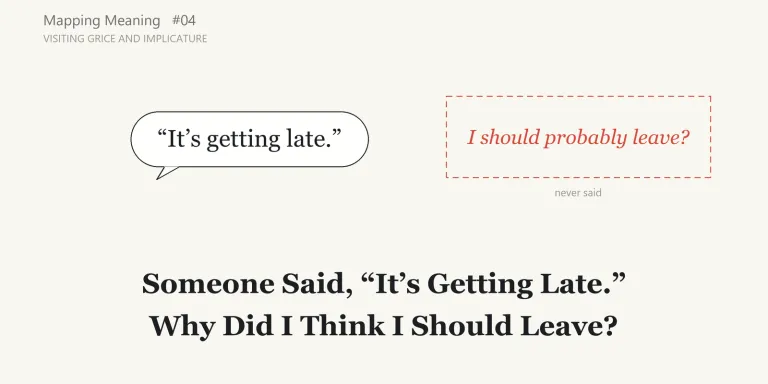
Mapping Meaning, Episode 4: Visiting Grice and Implicature
Where did “I should leave” come from?
It is eleven at night, at a friend’s home. We have been talking for hours. When the conversation reaches a pause, my friend glances at the clock and says:
It’s getting late.
My friend did not say “please go home.” Even so, I take it to mean that I should probably be on my way.
So where did that “I should be on my way” come from?
It is not in the sentence. On the surface, “It’s getting late” says something about the time. The words “go home” appear nowhere.
Yet it does not seem to be something I simply made up, either. Given the timing and the situation, it is natural for me to wonder whether my friend expected me to take it that way. But I cannot know that directly. If I had only replied, “Yes, it is late,” and carried on talking, my friend might well have been a little stuck.
So three things are already in play: what was said, what I took from it, and what my friend may have meant. I do not know the third directly. What I want to understand in this episode is how a meaning that goes beyond what was said comes about at all.
We receive a little more than was said
Put simply: the sentence “It’s getting late” says that it is getting late. In that moment, though, I received something more, roughly “I should probably leave.” I took away a little more than the words themselves carried.
One important way in which something can be conveyed without being explicitly said is called implicature. It is not the name for every kind of unstated meaning: in Episode 3, context was already doing other work, such as settling what words refer to and which reading of a word is in play.
This visit’s entry point was Wayne Davis’s entry “Implicature” in the Stanford Encyclopedia of Philosophy (SEP). It opens by saying that the word denotes either “the act of meaning or implying one thing by saying something else” or the object of that act. Implicature is a technical term here. It is not quite the everyday word “implication,” and it is not the same as entailment, what a sentence strictly commits you to. The entry also distinguishes implicatures fixed by the meaning of the sentence itself from those that arise in conversation. This episode is about the second kind, conversational implicature.
According to the entry, H. P. Grice was the first to systematically study cases in which what a speaker means differs from what the sentence the speaker used means. The entry’s first example goes like this. Alan asks Barb whether she is going to Paul’s party. Barb answers, “I have to work.” In a typical exchange, Barb meant that she is not going to the party. She did not say that she is not going, and the sentence she used does not mean that. Grice introduced the technical terms implicate and implicature for cases like this one, where what a speaker says differs from what they mean by saying it.
As before, this is not an expert’s explanation but a record of what I could understand from my reading. I have not read Grice’s own writings, such as “Logic and Conversation,” for this episode. Where I describe his ideas, I am describing them as the SEP entry presents them.
One step beyond Episode 3
In Episode 3, I looked at how the same remark, “It’s getting late,” is taken differently by a guest, by a team facing a deadline, and by a child up past bedtime. Context changes what is conveyed.
This time I am looking one step further. Using the context as a clue, the hearer appears to infer a meaning that was not stated. Getting from “it is getting late” to “I should probably leave” seems to involve some kind of inference.
This line, too, is less simple than it sounds. Near its opening, the SEP entry notes that an important issue in semantics is how to tell the senses and entailments of words and sentences apart from what it calls generalized conversational implicatures, those that arise across many conversations, and, relatedly, how far the meaning of a sentence determines what is said. That connects directly to the question of “what is said” that I ran into in Episode 3.
Why did they say that, now?
So what does the hearer use to reach that inference?
The intuition at Grice’s starting point is one that many people will probably recognize. The person we are talking with is not saying random, unrelated things. In some way, they are trying to make the conversation work. So when a remark seems slightly off, we do not throw it away. We ask: why did this person say this, now, in this way?
Barb, asked about the party, did not suddenly start talking about her job for no reason. If she is answering the question, then having to work must be the answer. Seen that way, “so I’m not coming” follows.
Grice postulated a principle addressed to speakers, which he called the Cooperative Principle. As the SEP entry states it: “Contribute what is required by the accepted purpose of the conversation.” On the hearer’s side, it works as a presumption: that the speaker is observing it, so that what the other person says must make some sense here.
He also spelled out four ways of meeting it, which he called maxims. In plain words, they are expectations: give as much information as is needed (Quantity); say what you take to be true (Quality); be relevant (Relation); be clear, and keep things in order (Manner). I will not go through them one by one. Many introductions to Grice exist, and covering him thoroughly is not my aim. What I want to know is how we read meaning beyond what was said.
One misunderstanding is easy to fall into here. “Cooperative” in this sense does not mean kind, friendly, or agreeable. Grice did assert, the entry reports, that people generally follow these rules for efficient communication, but that is not a claim that people are always cooperative.
The principle has its critics, too. The entry notes that it further assumes that the participants in every conversation strive only to achieve common goals, and reports the observation that “pure cooperation is generally an unrealistic idealization or naive assumption.” Conversations often take place between adversaries, and even friends and relatives frequently have goals that do not line up.
When an answer looks off, we look for another meaning
The most interesting part for me was not the list of maxims but how they are used.
Imagine this exchange:
“How was the food?”
“The staff were really friendly.”
The question was about the food, and the answer says nothing about the food. It falls a little short of what we would normally expect.
Yet we do not dismiss the answer as meaningless. We read it again: perhaps there was not much good to say about the food. That is a possible reading, not a settled fact. But the answer has invited it.
The SEP entry presents a famous example from Grice. Someone writing a reference letter for a student applying for a job in philosophy writes only that the student’s command of English is excellent and that his attendance at tutorials has been regular. That is the whole letter. Nothing is said about philosophy. By saying so little, the entry explains, the writer implicated that the candidate is a poor one. The entry gives it as the classic case of damning with faint praise.
Grice thought, the entry says, that some implicatures arise through flouting a maxim. In the entry’s words, this happens when what a cooperative speaker says “so patently violates a maxim that the hearer must infer that the speaker means something different.” Irony is the standard case. The entry’s own example is a truck driver trying to cross the Continental Divide in a blizzard, who, asked how the weather is, says, “The weather’s lovely.” He has said that the weather is lovely, and he means that it is terrible.
In cases like these, a remark departs, slightly or blatantly, from what we would ordinarily expect, and that departure sends us looking for a meaning behind it. The unsaid meaning is reached there, through inference.
“It’s getting late, but you don’t need to leave yet.”
There was one more feature that seemed likely to matter for Meaning Audit.
Suppose my friend had said:
It’s getting late, but you don’t need to leave yet.
The reading “I should probably leave” disappears. A meaning that the first sentence alone would have produced is withdrawn by the one that follows.
According to the SEP entry, it has been widely accepted, following Grice, that generalized conversational implicatures differ from implicatures fixed by sentence meaning in being cancelable. The entry also uses the party example to show what canceling looks like: Barb would not have implicated that she was skipping the party if she had added, “But I might be able to leave early.”
What a sentence says outright cannot be withdrawn so easily. If I say “It’s getting late” and then “but it isn’t getting late,” I have simply contradicted myself. A conversational implicature like the one in my friend’s remark, by contrast, can typically be taken back, although the entry notes cases in which an implicature cannot be explicitly canceled.

The inference has to be recoverable
The entry also reports a further condition in Grice’s account: conversational implicatures “must be capable of being worked out.” It calls this calculability. The idea is that the implicated meaning should be reachable by a line of reasoning: from what was said, the Cooperative Principle, and the context.
That changed how I thought about inferred meaning. On Grice’s account, it is not free association: there has to be a route that can be traced back to the clues. This is not a matter of proof. It is a matter of whether the step from what was said to what was taken can be laid out at all.
Grice did not settle everything
By this point, it can look as if Grice’s framework explains conversational implicature neatly. The SEP entry, however, says: “While Grice viewed his ideas as tentative and exploratory, followers have taken the theory to be well established.”
It goes on to list serious difficulties that have emerged: such principles predict more implicatures than actually arise; they often fail to settle which implicature is meant; the maxims can clash with one another; and speakers frequently have goals other than communicating efficiently. Some theorists modify Grice’s principles (Neo-Gricean approaches), and others replace them with a different principle (Relevance Theory).
I will not go into that later work here. But it seems worth saying plainly what Grice offered, at least as the entry presents it: an influential framework for asking how hearers infer meaning beyond what is explicitly said, not a theory that has finished explaining it.
Misleading without lying
Now I want to bring this a little closer to practical work.
The SEP entry notes that the difference between saying and implicating also matters for how we judge speakers. In the party example, if Barb knew she did not have to work, she was lying. But if she did have to work and knew all along that she was going to the party anyway, she might be guilty of misleading Alan, “but not of lying or making a false statement.”
Among the purposes implicature serves, the entry’s opening lists “misleading without lying.”
I am not interested here in judging who is or is not a liar. What caught my attention is something about reading. “It isn’t written, so that meaning isn’t there” does not hold. A text can lead its reader toward a conclusion without stating it.
But a reader’s inference is not the writer’s intention
The reverse does not hold either. That a reader took something from a text does not mean the writer intended it.
The entry says it is generally agreed that what a speaker means is determined by the speaker’s intentions. It also says: “What someone implicates is not given to us directly. We have to infer it from evidence.” The entry’s example of such evidence is ordinary: what Barb said, what Alan asked, the assumption that she was answering him, and some background knowledge.
So what a reader infers and what a writer implicated may coincide, or they may come apart. How to handle the space between them looks unavoidable when auditing documents.
What happens in documents?
From here on, I am not applying Grice’s conversational implicature to documents. Grice’s account is about what a speaker, or a letter writer, means by saying something to someone. A report’s headline, layout, and juxtaposed figures are not obviously one person’s act of meaning. What I want to take back is the distinction Grice’s account made visible: between what is explicitly stated and what a reader is led to infer. Some of the examples below also involve expressions that are explicitly written, such as a headline, whose effect on the reader goes beyond what the figures support.
Here are a few concrete cases. The companies and numbers are hypothetical.
A report says:
Sales increased 10% year on year.
Above it, in large type, is the headline:
Full Recovery
“Full recovery” does not follow from a 10% increase. If the previous year had fallen sharply, a 10% rise might still leave sales short of where they used to be. Even so, the headline invites the reader to take it that sales are back where they were.

In Episode 3, a similar report was about framing: the same text and chart read differently depending on the headline above them. Here the focus is narrower: what the explicit statements, taken together, lead a reader to infer beyond what any of them states.
In another report, the figure
Customer satisfaction was 80%.
comes with the caption
Highly rated by many customers
The number has had an evaluation attached to it: “many,” “highly rated.”
And one more. Two facts appear next to each other: the period in which a product failure occurred, and the period in which another company’s product was shipped. Nowhere does the document say that the other company’s product caused the failure. But the order in which the two facts are placed, and the headline above them, may lead a reader to take it that the other product was probably the cause.
How much does a document actually say? Where does the reader’s own inference begin? And when the document invites that inference, how should it be handled?
What this adds to Meaning Audit
From here on, I turn to my own side of this: what it means for Meaning Audit.
First, in ordinary words. What is written in a document and what a reader takes from it are two different things. Between them is the reader’s inference. That inference is not free association. It is invited by the document’s wording, its layout, and the assumptions the reader brings.
In Meaning Audit’s terms, it looks like this, using the sales report. The expressions “Sales increased 10% year on year” and “Full Recovery” themselves can be confirmed under Evidence / Source. What each means as written is a question for Interpretation. Whether “Full Recovery” goes beyond what the figure supports is asked under Inference / Warrant. That the headline sits on top in large type and is read first, which makes the reader’s inference feel natural, is the kind of thing the Context / Pragmatics stage looks at, as in Episode 3. And finally, whether the document as a whole adopts the meaning “sales are back where they were” is asked under Commitment.
(As in earlier episodes, I write Evidence / Source, Inference / Warrant, and Context / Pragmatics in full for Meaning Audit’s stages, and lowercase evidence and inference for the ordinary or academic words.)
Can meaning that is not written down be something Meaning Audit looks at? At this point in the project, the method already covered part of it. Among its finding types, it had one called CAUSAL_IMPLICATION, for cases where a correlation, a juxtaposition, or a sequence in time is presented or suggested as a cause. The product example above is exactly that. It also had AMPLIFICATION, for cases where certainty, strength, or scope is presented as greater than the grounds support. Meaning Audit had been designed to look at what is suggested, not only at what is stated.
Meaning Audit, however, was not judging the writer’s intention. In the method as I was using it, the AI’s part was to trace where meaning moved, expose it, raise questions, and classify, while the judgment was left to a person. On the view the entry reports as generally agreed, what a speaker means, and so what a speaker implicates, is tied to what the speaker intends. What Meaning Audit looks at, as I see it, is which expressions and which placements in a document invite which inferences. The two are similar, but they are looking at different places.
Cancelability also seemed useful for auditing, though this is my own idea rather than something Grice’s account says about documents. Because conversational implicatures can often be taken back, it makes sense to check whether the document contains anything that cancels the inference it invites. If the “Full Recovery” report somewhere says “still below the level of two years ago,” that works to weaken the reader’s inference. Whether a small note at the edge of the text can balance the inference produced by a large headline is a separate question, and one I cannot answer.
Here again, the two are not the same thing. Grice’s account of implicature concerns inference between a speaker and a hearer, while Meaning Audit is a way of tracing where meaning moved within a document. Still, the idea of recording explicit meaning and inferred meaning separately seems genuinely useful for Meaning Audit.
A map from Episode 4
As before, Meaning Audit’s stages and the questions raised by this visit are separate layers. I have not inserted Grice’s ideas into Meaning Audit’s stages. This time, the questions gathered around Interpretation, Inference / Warrant, and Context / Pragmatics.

The questions from this visit are not a formal model from Grice or from theories of implicature. They are questions I picked up from what I read for this episode.
What I learned
- We routinely take in more than people explicitly say. One important way this happens is called implicature; this episode looked at the conversational kind.
- On Grice’s account, that inference is not free association. It rests on the presumption that the speaker is observing the Cooperative Principle, on what was said, and on the context, and it must be capable of being worked out.
- Generalized conversational implicatures are widely treated as cancelable: what follows can remove an inference that would otherwise arise. That is where they differ from what a sentence says outright.
- Implicature can also be used for “misleading without lying.” Even what a document does not state can be something it leads its reader to infer.
- Grice’s framework is influential, but Grice himself viewed his ideas as tentative and exploratory, and criticism and revision have continued since.
What remains open
- How far can a meaning a reader inferred be attributed to the writer, or to the document? On the view the entry reports as generally agreed, implicature is tied to the speaker’s intention; Meaning Audit, as I was using it, did not judge intention. How should the two be connected?
- How far does a small canceling note at the edge of a text undo the inference created by a large headline?
- Does AI understand or produce implicature in Grice’s sense, the way people do? The SEP entry I read did not address generative AI.
- When implied meaning is involved, where should the boundaries between Inference / Warrant, Context / Pragmatics, and Commitment be drawn? (A question continuing from Episode 3.)
Next
“It’s getting late” carried more meaning than its words.
But what about “I promise”? That seems less like describing something than like doing something by saying it.
Next, I visit speech act theory, which looks at words as actions.
Sources
- Davis, W., “Implicature,” Stanford Encyclopedia of Philosophy (substantive revision 2024-01-10). https://plato.stanford.edu/entries/implicature/
- 野元裕樹「意味論・語用論 #6 グライスの含意の理論」東京外国語大学 講義資料(2024-05-27)https://www.tufs.ac.jp/ts/personal/nomoto/handout06-Implicature.pdf (consulted for the Japanese edition’s terminology; not cited in the English text)
Grice’s “Logic and Conversation” (1975), the original source of the reference-letter example, and the later work mentioned in the entry were not read for this episode. The reference-letter and blizzard examples are as presented in the SEP entry.
The Japanese original of this article: 「もう遅いですよ」と言われた。なぜ私は「帰った方がいい」と思ったのか