
· Series: Mapping Meaning · 19 min read
I Said, "I Promise." What Happened When I Said It?
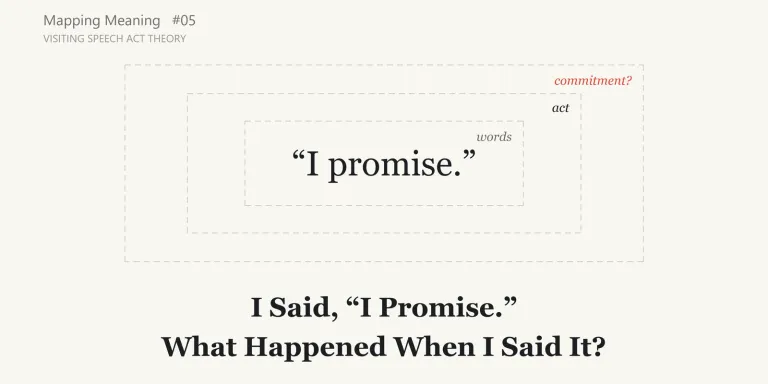
Mapping Meaning, Episode 5: Visiting Speech Act Theory
“I promise.”
I borrow a book from a friend. As I leave, I say:
I’ll bring it back tomorrow. I promise.
What does “I promise” tell my friend?
It does not seem to be information of the kind “I am now describing something called a promise.” Under ordinary conditions, by the time I finish saying it, I have made a promise. And something exists that did not exist before. If I do not return the book tomorrow, my friend can say, “You promised.” On my side, too, there is a sense that I have to return it.
Or take:
Sorry I’m late.
This is not just a report that I arrived late, or that I feel bad about it. In an ordinary case, saying it is itself an apology. If I write “Please check this,” I am asking someone to do something.
It seems that words do not only describe things; sometimes they do things. That feeling is where this episode starts.
Not true or false, quite
“It will rain tomorrow” can be asked about as true or false. If tomorrow is sunny, the sentence turns out to have been wrong.
“I promise” does not fit that question so easily. Even if I break the promise later, it seems odd to say that the words “I promise” were false. What was broken was the promise. As long as the right conditions were in place, the promise itself was made when I said it.
The philosopher J. L. Austin took a puzzle like this as a starting point. My entry points were two entries in the Stanford Encyclopedia of Philosophy (SEP): “Speech Acts,” by Mitchell Green, and “John Langshaw Austin,” by Guy Longworth. As before, this is not an expert’s explanation but a record of what I could understand from my reading. I have not read Austin’s lectures, How to Do Things with Words, or Searle’s books for this episode. Where I describe their ideas, I am describing them as the SEP entries present them.
According to Longworth’s entry, Austin’s lectures opened with examples such as naming a ship (“I name this ship the Queen Elizabeth,” said while smashing a bottle against the stern) and making a bet (“I bet you sixpence it will rain tomorrow”), and Austin wrote of them: “None of the utterances cited is either true or false.”
Utterances like these, where saying something is itself doing something, Austin called performatives. Utterances that describe how things are, and can be judged true or false, Austin called constatives. Austin began by exploring this distinction; as we will see, it did not stay clean. Longworth’s entry explains that constatives are assessed as true or false, while performatives are assessed along a different dimension, as happy or unhappy, felicitous or infelicitous. In plain terms: whether the act comes off, or comes off properly.
Saying the words is not always enough
Suppose someone with no connection to a wedding stops two strangers on the street and says, “I now pronounce you married.” The two do not become married. The words are in order, but the act of marrying them has not been successfully performed.
Green’s entry lists things that “only an appropriate authority, speaking at the appropriate time and place,” can do: christen a ship, pronounce a couple married, appoint someone to an administrative post, declare proceedings open, or rescind an offer. If I stand in front of a ship and announce a name for it without any authority to do so, I have named nothing. Longworth’s entry quotes Austin on a wedding that fails because one of the parties is already married, or because the ceremony is conducted by the purser rather than the captain. A bet, Green adds, cannot be made alone: I cannot bet you unless you accept.

Green’s entry describes two ways an act can go wrong: “Failures of felicity fall into two classes: misfires and abuses.” This is Austin’s distinction, as the entries present it. In a misfire, the act is not performed at all, as with naming a ship without the authority to do so. In an abuse, the act is performed but falls short of the standard appropriate to acts of its kind. The example is a promise I have no intention of keeping. The promise was made; it was just not sincere. Green calls sincerity “a paradigm condition for the felicity of speech acts.”
So an insincere promise can still be a promise. Whether the promise is later kept is another question.
Three things can happen when we speak
The room is cold. I say to someone nearby:
Can you close the window?
At least three things seem to happen here. I say a meaningful English sentence. In saying it, I ask the other person to do something. And, as a result, something happens: they get up and close the window, or perhaps feel slightly put upon.
Austin separated these. As Longworth’s entry describes them, the locutionary act is the act of saying something with a certain content; the illocutionary act is what one does in saying it, such as making a request, a promise, a warning, or a statement; and the perlocutionary act concerns the effects one brings about by saying it on the feelings, thoughts, or actions of the audience or others.
Longworth’s entry gives an example. If I promise that I will be home for dinner, and on another occasion state that I will be home for dinner, the content is the same, but one has the force of a promise and the other the force of a statement. The illocutionary acts differ. And if I warn that the ice is thin, that is one illocutionary act, but through it I may perform various perlocutionary acts: I may persuade someone to stay off the ice, or encourage someone to take the risk.
Green’s entry draws the line this way: I can both urge you and persuade you to shut the door, but urging is an illocution and persuading is a perlocution. Under the right conditions, I can urge just by saying the right thing; whether I have persuaded you depends on the effect my words have on you. In the same way, under ordinary conditions, asking someone to close the window is complete when I ask. Whether the window gets closed is another matter.

According to Longworth, the need to draw this three-way distinction is now very widely accepted and probably amounts to Austin’s central contribution to later work.
Where this overlaps with the last episode
“Can you close the window?” is, by its grammar, a question about whether the other person is able to close it. In an ordinary situation like this, though, it is usually taken as a request.
That looks a lot like the implicature of Episode 4. Green’s entry gives the same kind of case, “Can you pass the salt?”, normally taken as a request, as an example of what are called indirect speech acts. The entry suggests that indirect speech acts, if they occur at all, can be explained within the framework of conversational implicature. It also notes that Searle’s influential account of them is couched in terms of conversational implicature, although that phrase does not appear in it.
So implicature and speech acts are not neatly separate territories. Still, the direction of the question is a little different. Episode 4 asked how a meaning that was not said gets across. This episode asks what is done by saying something. “I promise” does not need an unstated message of the Episode 4 kind in order to function as a promise. Even so, under the right conditions, saying it brings a promise into being.
The simple split did not survive
So far it can look as if there are two kinds of words: words that state truths, and words that perform acts. It turned out not to be that simple.
According to Longworth’s entry, much of Austin’s book seems to be devoted to drawing a distinction between performatives and constatives, but none of the attempts succeeds. Attempts to state something can misfire or be abused too. And a warning, “the bull is about to charge,” may be criticized as mistaken rather than unhappy if the bull is not about to charge.
Longworth’s entry offers its own reading of this: “A more plausible interpretation,” it says, is that Austin’s purpose was not to draw such a distinction, but to argue, through the failure of the attempts, that there is no simple sorting of sentences into those apt for performative and those apt for constative use. That is Longworth’s interpretation, not something Austin is reported to have stated. On this account, “from the wreckage of the initial distinction,” Austin assembled the model of the three kinds of act above. A Japanese university course handout I used for the Japanese edition summarizes this second stage as the idea that all use of language is the performing of an act. Stating something, too, would then be an act.
What makes an utterance count as a particular act is itself still debated. As Green’s entry presents it, Austin held that for each speech act there must exist an accepted conventional procedure, including the uttering of certain words by certain persons in certain circumstances. Searle, Austin’s student, took speech acts to be characteristically performed by uttering sentences in accordance with constitutive rules. P. F. Strawson objected that, although there may be conventional postures or procedures for entreating someone, an entreaty need not conform to any such convention. Green’s entry itself says that intending to make an assertion, promise, or request “is not enough to perform one of these acts.”
I could see Searle only through the SEP entry. It reports that Searle and D. Vanderveken analyzed illocutionary force into several components. Among them are content conditions: for instance, I can only promise what lies in the future and under my control, or at least nothing that both of us can see I cannot do. Another is sincerity conditions: a promise expresses an intention, an apology expresses regret. This is not an essay surveying speech act theory, so I will stop there.
Saying can mean taking something on
The idea that made me think hardest this time was that not only special words like “I promise” but also ordinary statements involve taking something on.
In a section on an intentionalist alternative to convention-based accounts, Green’s entry describes a line of thought on which speech acts involve the “intentional undertaking of a publicly accessible commitment.” Elsewhere, the entry notes that someone who asserts something can fairly be asked, “How do you know?”, while a conjecture is not open to that challenge in the same way. And in presenting Searle and Vanderveken’s components of illocutionary force, it gives the characteristic aim of a promise as committing oneself to a future course of action.
Seen this way, a question comes naturally: who took on what, and how strongly?
What happens in documents?
From here on, I am not applying speech act theory directly to documents. What I want to bring back is the question it raised: what is being done with these words? The examples below are hypothetical.
Suppose a report ends with this sentence:
We will definitely improve.
At this point in the project, I framed the question this way: is this a forecast that things will get better, or is the organization undertaking to improve? If no improvement follows, then, read as a promise, it lets a reader say, “You promised.” Read as a forecast, it simply turned out to be wrong. Depending on which act the sentence is read as, the weight of what the writer took on changes.
(Looking back, in this particular scenario the second reading is more natural: a responsible party is ending its own report with the sentence. At this stage, though, I had not yet separated that question clearly from the others.)
Another document says, “The company will adopt this policy.” That may simply report something already decided. But if the document itself was approved in a meeting, it may be the very act of making the decision public. Within a single document, “It appears that…” states, “We should…” recommends, and “Please confirm…” requests. “We will implement…” might be a promise, a decision, or a report of what is scheduled.
Who has the authority to do that?
And, as with naming a ship or appointing someone, there is the question of whether the person has the authority to do the act. Suppose an employee writes to a client, “We guarantee this on behalf of the company,” without having the authority to speak for the company. What happens to that guarantee? Is it a misfire, like an unauthorized naming, or has something been taken on in another form? The entries I read deal with institutional settings such as naming and appointing. They did not deal with who the speaker is when a text is written in an organization’s name.
What this adds to Meaning Audit
From here on, I turn to my own side of this: what it means for Meaning Audit.
When reading a document, besides what is written and what is conveyed, I can also look at what is being done with the text. Is it stating, recommending, promising, deciding, or requesting? And who is doing it?
Here the Meaning Audit stage and the ordinary word meet, so I will mark them as in earlier episodes. I write Commitment for the Meaning Audit stage and lowercase commitment for the ordinary or theoretical term, as in “publicly accessible commitment.” This is a convention for keeping two uses apart on the page. It is not a claim about how the concepts relate.
At this point in the project, the version of Meaning Audit I was using defined Commitment as an output adopting a meaning as a judgment, a conclusion, or a recommendation. The audit checked whether the strength of that adoption (an assertion, a recommendation, a possibility put forward, a qualified statement) matched the state of the grounds. The method also had a finding type, COMMITMENT_ESCALATION, for cases where an inference or a possibility is adopted as a judgment, conclusion, or recommendation.
Why have a Commitment stage at all? Reading speech act theory, I felt I could see one reason, at least as I understand the stage. A document does not only lay out information. It can assert or recommend, and in some settings its wording may be used to promise or decide. In each case, something is being taken on. So, apart from what is written and what can be inferred, it makes sense to have a stage that looks at what the document finally took on. The stage was already part of the method before this visit; the visit gave me one way of seeing why it might be needed.
Still, I could not establish that the two are the same concept, though that does not mean they are unrelated. Speech act theory, in what I read, deals mainly with the acts speakers perform by speaking and the conditions under which those acts come off. Commitment, as I was using it then, looked at which meanings a document adopted as judgments, conclusions, or recommendations, and whether that strength matched the grounds. In the version I was using then, the method distinguished assertion from recommendation and recorded degrees of strength. It had no way of recording different kinds of act, such as promises, decisions, or requests, separately. Whether it needs one, I do not yet know.
One more thing. At that stage, Commitment was written as what “the output” adopts. Speech act theory sends back the questions “who?” and “with what authority?” Meaning Audit, as I was using it, did not judge the writer’s intention. But in whose name, and from what position, something was put forward may be clues that can be checked on the document itself.
The AI says, “I promise.”
Suppose I contact a company and an AI assistant replies: “I’ll look into this and get back to you. I promise.” Whose speech act is this?
Did the AI promise? The company that provides it? The user who generated the text and sent it on? Or has no promise been made at all?
The two SEP entries I read did not discuss AI or machines as speakers. Green’s entry mentions artificial intelligence as a field that has used speech act theory, for instance to help automated systems work out the plans of human agents, and elsewhere it mentions people speaking to machines. Whether an AI can promise, apologize, or take anything on in the sense these entries describe, I cannot say. I am leaving it as something I do not know.
A map from Episode 5
As before, Meaning Audit’s stages and the questions raised by this visit are separate layers. I have not inserted speech act theory into Meaning Audit’s stages. This time the questions gathered at Commitment, with a second cluster, about authority, at Context / Pragmatics.

The questions from this visit are not a formal model from speech act theory. They are questions I picked up from what I read for this episode.
What I learned
- Words do not only describe how things are. Sometimes saying something is itself an act, such as promising, naming, or apologizing. Austin started from there.
- Such acts do not always come off just because the words were said. Authority, situation, sincerity, and sometimes the other person’s uptake matter, in different ways for different acts. A distinction is drawn between acts that do not come off at all (misfires) and acts that come off but are defective (abuses).
- The same content can be a promise or a statement, depending on what is done with it. Saying something, what is done in saying it, and what follows from it can be considered separately.
- Austin’s attempts to sort words neatly into “stating” and “doing” did not succeed, and Longworth’s entry suggests this was the point. On one line of thought that Green’s entry describes, stating something also involves taking something on.
- Meaning Audit’s Commitment stage, as I was using it then, looked at what a document finally adopted, and it seems to touch on speech act theory. I could not establish that they are the same concept.
What remains open
- When a text is written in an organization’s name, who is the one performing the speech act? The sources dealt with institutional authority, but not with an organization itself as the speaker.
- How should a “We guarantee this” written by someone without authority be handled in an audit? As a misfire, or as a different kind of Commitment?
- Whose promise is an AI-generated “I promise”? Is it a promise at all?
- How far does Meaning Audit’s Commitment connect with the concepts of speech act theory? Does the method need to record kinds of act, such as promises, decisions, and requests, separately?
Next
A promise is easy to follow when speaker and listener are in the same place. Who spoke, and in what role, can be seen on the spot.
But most of the texts we read are far removed, in time and place, from when and where they were written, and from their writers’ situations. How should someone reading “We will definitely improve” in a report written years ago understand it?
Next, I visit hermeneutics, with the question of whether reading means extracting a meaning that is already in the text.
Sources
- Green, M., “Speech Acts,” Stanford Encyclopedia of Philosophy (first published 2007-07-03; substantive revision 2020-09-24). https://plato.stanford.edu/entries/speech-acts/
- Longworth, G., “John Langshaw Austin,” Stanford Encyclopedia of Philosophy (first published 2012-12-11; substantive revision 2025-06-09). https://plato.stanford.edu/entries/austin-jl/
- 立命館大学「論理学概論II」授業資料「オースティンと言語行為」 https://www.ritsumei.ac.jp/~tit03611/courses/phllg2j.html (Japanese course handout used for the Japanese edition; cited here only for its summary of the second stage of Austin’s argument)
Austin’s How to Do Things with Words (1962), Searle’s Speech Acts (1969) and Searle’s papers on indirect speech acts, Searle and Vanderveken’s joint work, and Strawson’s papers were not read for this episode. Austin’s examples and words are as quoted or reported in the SEP entries.
The Japanese original of this article: 「約束します」と言った。そのとき、何が起きたのか