
· Series: Mapping Meaning · 24 min read
I Read "We Will Definitely Improve" Five Years Later. What Am I Reading?
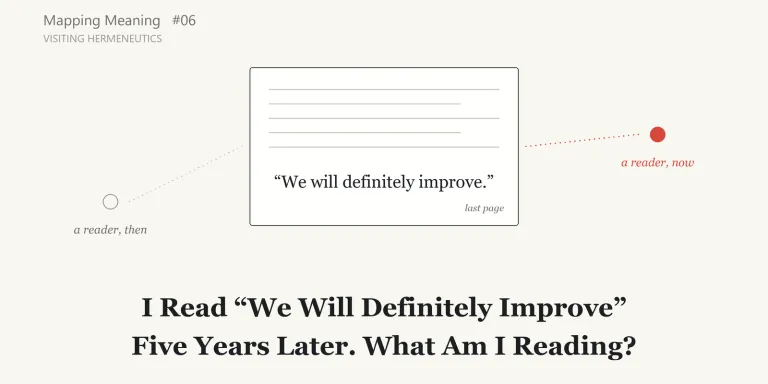
Mapping Meaning, Episode 6: Visiting Hermeneutics
A report from five years ago
I have moved to a new department, and I am reading the documents my predecessor left behind. On the last page of a report written five years ago, there is this sentence:
We will definitely improve.
The person who wrote it is no longer in the department. The report does not say clearly what was to be improved, who the sentence was addressed to, or what was going on at the time.
Even so, when I read the sentence, I feel I have understood something. The department acknowledged the problem and promised to improve.
But where did that sense of understanding come from? I did not read the mind of the person who wrote it five years ago. I read only the words that remain on the page. And I read them with my own workplace in mind: its current circumstances, the problems that have come up recently.
Am I reading what the writer meant five years ago? Or am I reading what the sentence means for me now? In the last episode I asked what is done by saying a sentence like this. This time I start from a different question: what happens when the same sentence is read years later, by someone the writer may never have had in mind.
The feeling that I already understood it
We usually assume that reading means taking in the meaning as it was written. If something is unclear, we look up that part and move on.
There is a position that does not start from this assumption. In the Stanford Encyclopedia of Philosophy (SEP), Michael Forster’s entry on the theologian and philosopher Friedrich Schleiermacher presents one of his principles this way: contrary to the common misconception that “understanding occurs as a matter of course,” in fact “misunderstanding occurs as a matter of course, and so understanding must be willed and sought at every point.”
My sense of having understood the five-year-old report may have been exactly the kind of understanding that happens by itself. That does not make it wrong. It makes it something I had not yet checked.
The field that asks what interpretation is, and what it involves, is hermeneutics. Theodore George’s SEP entry “Hermeneutics” begins: “Hermeneutics is the study of interpretation.” It goes on to say that the disciplines that have traditionally relied on hermeneutics include theology, especially Biblical studies, jurisprudence, and medicine.
My way in this time was George’s entry, together with three other SEP entries: Jeff Malpas’s “Hans-Georg Gadamer,” the entry “Paul Ricoeur” by David Pellauer, Bernard Dauenhauer and Scott Davidson, and the hermeneutics section of Forster’s “Friedrich Daniel Ernst Schleiermacher.” For the Japanese edition, I also used a Japanese paper on Gadamer’s Truth and Method (listed in the sources) to check translated terms. As in earlier episodes, I am not explaining these thinkers as a specialist. I am recording what I could understand from what I read. I did not read the original works of Gadamer, Schleiermacher or Ricoeur for this episode.
Parts change the whole, and the whole changes the parts
From the sentence alone, I cannot tell what “improve” refers to. I have to read the previous page, where the problem is described, before I can guess: so this is about the delay in that procedure. But I cannot tell which parts of that previous page matter unless I understand what the report as a whole was written for.
George’s entry describes this relation in its classic form. It is necessary to understand a text as a whole in order to understand any of its parts properly, and it is necessary to understand the text in each of its parts in order to understand it as a whole. This is the idea known as the hermeneutical circle, and George notes that this formulation goes back to antiquity.
According to Forster’s entry, Schleiermacher did not see this circle as vicious. His solution was that understanding is not all-or-nothing but comes in degrees. We interpret each part as well as we can and form an approximate picture of the whole. We use that picture to refine our reading of the parts, which gives us a better picture of the whole, which can then be used again, and so on indefinitely. The back-and-forth is a way of making progress, not a trap.
The image of the circle has not gone unquestioned. George’s entry adds that even within hermeneutics it has been challenged whether interpretive experience is really circular.
What did the writer mean?
Schleiermacher held that interpretation has two sides. As Forster presents it, one is linguistic: it works out meaning from the rules of usage shared in a language. The other is psychological: it focuses on what is distinctive to a particular author. The ordinary meaning of “improve” and what this writer meant by it are two separate things to consider.
The psychological side is not mind-reading. Forster explains that Schleiermacher saw this side as relying mainly on what he called a “divinatory” method, and glosses it as a method of “tentative, fallible hypothesis” based on the available evidence, while going well beyond it. Forster notes that the word should be heard less as prophecy than as the French deviner, to guess or conjecture.
Schleiermacher also held, according to the entry, that before interpretation proper can begin, the interpreter must acquire a good knowledge of the text’s historical context. For the five-year-old report, that would mean first finding out what problem had occurred at the time and who the report was written for.
One passage in Forster’s entry caught my attention. In explaining why Schleiermacher thought the psychological side was needed, Forster uses vocabulary from a later period. To understand a linguistic act fully, he writes, one needs to know not only its linguistic meaning but also what “more recent philosophers have called its ‘illocutionary force’ or intention.” The phrase is not Schleiermacher’s own; Forster borrows it from later philosophy. Still, in the terms of the last episode, it comes close to saying that we need to understand not only what the words mean but what was being done with them. For a sentence like the one in this report, written by the responsible side at the end of a report about a problem, the natural reading is a commitment: an expression of the will, or the promise, to improve.
Schleiermacher is also known for saying that the interpreter should aim to understand an author better than the author understood himself. George’s entry presents this as the task “to understand the discourse just as well or even better than its creator.” Forster’s entry, however, reads the doctrine in a limited sense. Given Schleiermacher’s general skepticism about the unconscious, Forster suggests, he probably meant little more than that the interpreter should come to know explicitly the linguistic rules that the author grasped only implicitly. Following Forster’s reading, taking the phrase to mean reading the writer’s unconscious may go too far.
I do not read from nowhere
Up to this point, the question has been how to get closer to the writer and the writer’s time. In the twentieth century, Hans-Georg Gadamer approached the question from another angle.
When I read the five-year-old report, I am not reading it with a blank mind. I bring my workplace’s current circumstances, the problems that have come up recently, and the experience that promises made in reports are often not kept.
Ordinarily, we think assumptions like these have to be removed if we are to read correctly. Gadamer did not think so. According to Malpas’s entry, Gadamer argued that, “rather than closing us off, our prejudices are themselves what open us up to what is to be understood.” The word here is prejudice (German Vorurteil), which Malpas notes goes back to the literal sense of a pre-judgment. In English as in Japanese, the everyday word has a negative sound. The Japanese paper I used renders Vorurteil with a scholarly term, and notes that the everyday Japanese word for a preconception carries a negative image, much like the word for bias.
Gadamer did not say that every prejudice is a good one. Malpas’s entry states plainly that Gadamer acknowledged that prejudices can sometimes distort; the point is that they do not always do so. The entry also says that in the dialogue of understanding our prejudices come to the fore and become evident, and that they can then become the focus of questioning in their own turn.
Gadamer also held that our understanding is shaped by what has been handed down through history. George’s entry calls this the principle of “history of effect,” and explains it this way: “our attempts to understand are always guided more by tradition, and thus prejudice, than we are able to make explicit to ourselves.” I cannot see through everything I am assuming when I read.
Understanding includes application
Gadamer also held that understanding involves application. According to Malpas’s entry, all interpretation, even of the past, is “always oriented to present concerns and interests.” The entry quotes Gadamer’s Truth and Method: “application is neither a subsequent nor merely an occasional part of the phenomenon of understanding, but co-determines it as a whole from the beginning.”
When I read the report’s “We will definitely improve,” I read it with questions like these: So where do things stand now? How are we supposed to carry this forward? I probably cannot set those concerns aside and extract only what the sentence meant five years ago.
That is not a license to make the sentence say whatever suits the present. As I understood it, application here means that the reader’s present concerns are part of understanding from the start. It does not mean the reader is free to rewrite the text. The prejudices that make reading possible can also distort it, and they can be questioned.
George’s entry reports that Gadamer describes the expansion of our horizons as a “fusion of horizons,” and cautions that the term is “perhaps misleading,” because it can be taken to mean that an interpreter has one distinct horizon which is then expanded by absorbing another, such as the horizon of a text. I will not go into the term here. What I am taking back from it is a question: can a reader step entirely out of the present to read a text from the past?
The text survives its writer
Does this mean that what the writer meant no longer matters?
Before answering, I want to look at Paul Ricoeur, who paid attention to what writing does. According to the SEP entry on Ricoeur, spoken language is ephemeral: it disappears. “The event of speaking might disappear, but the text remains for anyone who knows how to read.” Hence, the entry continues, it is the meaning of the text, rather than the original author’s intention or the originating situation, that becomes the object of interpretation. The entry also describes something like a “world of the text,” which lies “not behind the text but metaphorically in front of it,” as something for the interpreter’s imagination to explore.
The writer of the five-year-old report is no longer here. The report remains, and I am the one reading it. Ricoeur’s view, as the entry presents it, seems to fit this situation quite well.
The same entry also says that a good reading opens interpreters to having their initial assumptions questioned by the text. For me, that adds an important qualification: the text is not only something the reader acts on.
So is the writer’s intention irrelevant?
If I stopped here, the lesson could become: the writer’s intention does not matter; whatever the present reader finds is the meaning. When I looked further, it was not that simple.
The entries do describe Gadamer as moving away from the writer’s inner meaning. Malpas’s entry says that Gadamer rejected the idea of understanding as achieved “through gaining access to some inner realm of subjective meaning.” George’s entry says that the claim that the hermeneutical experience of truth, in Gadamer’s sense, is conditioned by tradition “is not reducible to” concern with working out what an author took to be true by reconstructing the author’s intention, the historical context, or both. Not reducible to is not the same as irrelevant.
The entries also report criticism. George’s entry notes that some argue Heidegger and Gadamer, by stressing the existential, traditional and linguistic conditions of interpretation, take attention away from questions about what criteria should be used to evaluate what makes an interpretation good. It also reports Jürgen Habermas’s objection that philosophical hermeneutics, with its adherence to the authority of tradition, leaves no room for the critique of ideologies entrenched in the prejudices we inherit, along with Gadamer’s reply that interpretive experience remains critical because it questions which of our prejudices remain valid and which have become invalid.
Recognizing that readers are historical and bring prejudices does not make the question of criteria disappear. How much weight should the writer’s intention carry, and in what form? In what I read, I could not find a single answer.
This is not an overview of hermeneutics, so I will not follow those debates further. Readers who want to go further can start with the SEP entries listed at the end.
Five years later, the promise is still a past promise
From here, I am not applying hermeneutics as such to documents. I am taking one point I drew from it, that the reader’s present enters into reading, and bringing it back to documents. As before, these are hypothetical examples, including the report I started with.
Take the report’s “We will definitely improve” again, one step at a time.
First, five years ago. People who read the report then would most likely have read the sentence as a commitment to improve from that point on.
Second, now. Reading it five years later, I also read it as a commitment to improve, made at that time. It is the same commitment that was made then; five years have not changed that.
Third, the words. Not one of them has changed.
Fourth, the reader. What has changed is my position in time and my situation, and so the questions I bring: Was the commitment kept? What happened afterward? What does it mean for us now, and who is carrying it?
Fifth, then: time does not rewrite the text. It can change the questions we bring to it, and how it bears on the person reading it now.

A policy document is a different case. There, the reading itself can drift. Suppose a “Customer First” policy was written ten years ago. At the time, it may have meant responding quickly to complaints. A person responsible for it today may read it as meaning that customer data must be handled with care. In both cases the words are the same “Customer First.” Here it is not only the questions that have moved; the reading itself may have moved. The report sentence and the policy are kept apart for that reason.
And the person auditing a document is in the same position as any other reader. An auditor cannot read with a blank mind either. They read with their present concerns, their past experience, and their own view of the document.
The SEP entry on Ricoeur has a sentence that fits here: “Interpretations, of course, need to be checked against and challenged by other interpretations, and they will sooner or later need to be redone as situations change over time.” One reading does not settle the meaning.
The auditor is also a reader
What follows is my own reflection, not something the sources say. As in earlier episodes, I write Meaning Audit’s stage names in capitals, such as Interpretation or Commitment, and the same words in lowercase when they are used in their ordinary or academic senses.
First, in plain terms. When we read a document, we read the words that are written. But our present situation and concerns enter into that reading. With documents written some time ago, the writer’s circumstances are often no longer known. Even so, the reader ends up “understanding” something.
In the version of Meaning Audit I was using then, there were already ways to record this kind of not-knowing. At the start of an audit, the auditor identified the audit object, including its author or source and its date, and marked anything that could not be identified as UNKNOWN. Each element of the supporting material was given an information state: KNOWN, INFERRED, UNKNOWN or CONFLICTING. And at the Inference / Warrant stage, if no warrant connecting the grounds to a conclusion was stated, any warrant the auditor supplied was to be marked INFERRED and not treated as fact.
Looking back at Meaning Audit after reading hermeneutics, I could read that last rule in another way as well: as a way of keeping the auditor’s own reading apart from what is directly written in the document. I am not saying the method was designed with this in mind. It is a reading of the method that came into view after this visit.
Take the report again. In this context, reading “We will definitely improve” as a promise is the natural reading. But the report does not say, “This is a promise.” Seen through that distinction, I would keep the wording as KNOWN, since it can be checked directly in the document, and mark the promise reading as INFERRED, the auditor’s own inference.

INFERRED does not make a reading objective
Writing INFERRED does not remove the auditor’s prejudices. The warrant the auditor supplied may itself come from those prejudices. INFERRED is not a label that guarantees a reading is objective.
What it can do is expose a location: from here on, the auditor’s own reading has entered.
Whether an auditor can fully identify their own prejudices is UNKNOWN. If George’s gloss on the “history of effect” is right, there is reason to doubt it, but I did not find anything in the sources about auditors, and I leave it open.
Which context are we auditing?
Hermeneutics also sends new questions back to Meaning Audit, at three stages.
The first question concerns Interpretation. In the version of Meaning Audit I was using then, this stage looked at how the grounds were interpreted and turned into the meanings presented in the document. It also checked whether the document kept what the evidence said apart from the author’s interpretation of it. But the auditor’s reading, in checking that interpretation, is itself an interpretation. That does not make the stage invalid. It means the stage is recursive: the auditor interprets the document’s interpretation. How far can the auditor notice and record their own prejudices?
The second concerns Context / Pragmatics. In the version of Meaning Audit I was using then, this stage looked at headings, order, vocabulary, emphasis and figures, and it also asked how the intended readers would take the wording. But a reader who comes to a document years later may be someone the writer never had in mind. Should the audit be based on the context in which the document was produced, or the context in which it is being read? Or should it record both, separately?
For the five-year-old “We will definitely improve,” both contexts point to the same commitment to improve. In the context in which the report was produced, that commitment was forward-looking: it was about what was to come. In the present reading context, it is a past commitment, and a starting point for asking what happened afterward. The commitment is the same; what differs is where it stands in time relative to the reader. This was the largest question this visit left me with. I am leaving it as a research question, not as a change to the method.
What happens to Commitment over time?
The third concerns Commitment. In the last episode, I came to think that something can be taken on through a document, while leaving open who is actually doing the taking on. So does what was taken on in a five-year-old document remain taken on today?
The person who wrote it has moved on. The management may have changed, and so may the organization’s policies. Does the Commitment carried in the document five years ago still remain with the organization now? If it does, who has inherited it?
There are two different questions here. One is whether there was a past commitment at all. In this example, the natural reading says yes, and under the distinction above I would record that reading as INFERRED. The other is who, if anyone, carries it now. That one is UNKNOWN. What I read for this episode did not answer it.
Seen this way, Meaning Audit audits the meaning of its object, but the auditor reading that meaning may not be able to stand outside the process by which meaning comes about. The takeaway I bring from this visit is this: the auditor cannot simply be treated as standing outside interpretation. That is my conclusion, not a quotation. If it holds, what Meaning Audit can offer is not a guarantee of a fully objective reading. It can expose what is in the material itself (the evidence), where the auditor’s own reading begins (INFERRED), what is not known (UNKNOWN), and in which context the document was read.
That does not make hermeneutics and Meaning Audit the same kind of thing. Hermeneutics asks what understanding and interpretation involve. Meaning Audit is a practical method for tracing where meaning moves within an artifact and its supporting chain. The former does not validate the latter, and I am not using it to.
What assumptions does AI read with?
One last question I want to leave here.
People increasingly ask AI to summarize or interpret old documents. When an AI summarizes a five-year-old report, what does it read with? Does it have something like prejudices? If it does, whose are they, and from when?
In the four SEP entries I read, I found no discussion of AI or of machine reading. Gadamer’s prejudice is an analogy I am tempted to ask about here, not one the sources make. What AI brings to its reading is UNKNOWN.
A map from Episode 6
As in earlier episodes, the left side shows Meaning Audit’s stages, and the right side shows questions raised by this visit. The ideas of hermeneutics are not inserted into Meaning Audit’s stages. This time the questions gathered at Interpretation and Context / Pragmatics, and a question about time was added to Commitment.

Note: the questions on the right are not a formal model from hermeneutics. They are questions I picked up from what I read.
What I learned
- Hermeneutics is the study of interpretation. It was traditionally relied on by disciplines such as theology, law and medicine, and in philosophy it came to treat interpretation itself as its subject.
- Understanding the parts needs the whole, and understanding the whole needs the parts. Schleiermacher, as Forster presents him, treated this back-and-forth as a way of improving understanding by degrees.
- Gadamer, as Malpas presents him, reconsidered the reader’s prejudices as a condition of understanding rather than simply an obstacle. He also acknowledged that prejudices can distort.
- On one view, application to the present is part of understanding from the start. It is hard to read a text from another time without one’s present concerns.
- How much weight the writer’s intention should carry is still debated within hermeneutics, and in what I read it did not come down to a single answer.
- A past commitment does not become a different commitment five years later. What changes is the reader’s position, the questions the reader brings, and how the sentence bears on the present.
What remains open
- Should a Meaning Audit be based on the context in which a document was produced or the context in which it is read? Or should it record both separately? Even for the same “We will definitely improve,” the questions brought to the commitment change over time.
- How far can an auditor notice and record their own prejudices? Writing INFERRED shows where a reading entered; it does not remove the prejudice behind it.
- After the writer has left and the management and policies have changed, does a commitment carried in a five-year-old document still remain with the organization? If so, who has inherited it?
- When AI reads an old document, what does it read with? The sources I read do not discuss AI.
Next
This time I looked at how the reader, too, takes part in the coming about of meaning. Then what is it that we are “reading” in the first place?
So far, this series has kept its eyes on words: what is said, what comes across without being said, what is done by saying, and what happens when something is read across time.
But are words the only thing in a document? Numbers, the colors in a chart, the direction of an arrow, the layout of a figure. Things that are not words may mean something too.
Next, I will visit semiotics, with this question: how do words, numbers, figures and images come to mean anything?
Sources
- George, T., “Hermeneutics,” Stanford Encyclopedia of Philosophy (first published 2020-12-09; substantive revision 2025-04-30). https://plato.stanford.edu/entries/hermeneutics/
- Malpas, J., “Hans-Georg Gadamer,” Stanford Encyclopedia of Philosophy (first published 2003-03-03; substantive revision 2022-08-22). https://plato.stanford.edu/entries/gadamer/
- Pellauer, D., Dauenhauer, B. & Davidson, S., “Paul Ricoeur,” Stanford Encyclopedia of Philosophy (first published 2002-11-11; substantive revision 2026-01-05). https://plato.stanford.edu/entries/ricoeur/
- Forster, M., “Friedrich Daniel Ernst Schleiermacher,” Stanford Encyclopedia of Philosophy (first published 2002-04-17; substantive revision 2022-05-19), hermeneutics section. https://plato.stanford.edu/entries/schleiermacher/
- 土方尚子・下山千遥・川村壮平「H.-G. ガダマー『真理と方法』の意義とその射程 ― 芸術・精神科学・言語」『哲学の探求』第52号, 2025 (Japanese; used for the Japanese edition’s translated terms). https://www.jstage.jst.go.jp/article/wakateforum/2025/52/2025_81/_pdf/-char/en
Gadamer’s Truth and Method (Wahrheit und Methode, 1960), Schleiermacher’s lectures on hermeneutics, Ricoeur’s works, the original texts of the Habermas–Gadamer debate, and the later studies mentioned in the entries were not read for this episode. Gadamer’s and Schleiermacher’s words are as quoted or reported in the SEP entries.
The Japanese original of this article: 五年前の「必ず改善します」を読む。私は何を読んでいるのか